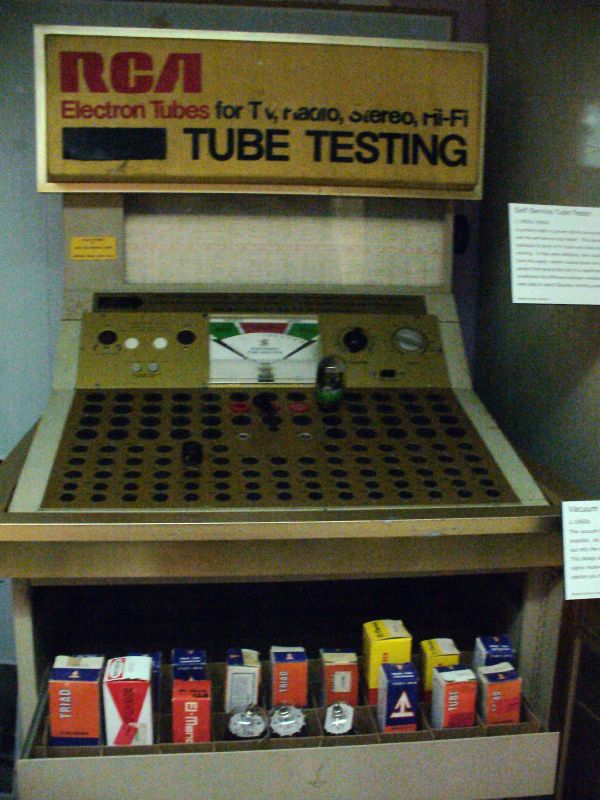
Growing up in the 60's, I was fascinated by the tube testers that seemed to be in every retail store (thank you to
Flickr user KB35 for sharing the photo shown here). As I got a little older I finally understood their purpose. Amateur TV and radio repairmen could figure out what was wrong with their equipment by removing and testing the various tubes of all shapes and sizes, and replacing the bad ones. It was an economical way of fixing what was broken without having to fully understand the technology.
Flash forward 40 years or so. I had given my sister our 4 year old Samsung DLP television in January. Over the course of the past few weeks the TV would start making an awful sound after about 30 minutes of viewing. Turning the TV off for awhile would temporarily alleviate the problem, but after another 30 minutes the problem was back.
I Googled the symptoms, and learned that there are only 2 moving parts inside this TV, and most likely the noise was caused by failed bearings inside the color wheel. Next, I was able to find the part number (no thanks at all to Samsung's online chat support), and a vendor in Dayton, Ohio that could have the replacement color wheel in my hands in one day for a grand total of about $120.
On to the next issue: figuring out how to actually take the TV apart and replace the defective part. I was able to find some printable directions with pictures using Google (although I later figured out it was a slightly different procedure for this model DLP). But even better-- I found a series of 5 videos on YouTube created by
Hexagontaginal.Like me, Hexagontaginal was an amateur repairman who found written directions for replacing the color wheel, and at the urging of a friend, he decided to set up a video camera on a tripod and video tape the whole process. Coincidentally, his television was the exact model number as the one I was attempting to repair.
So last Saturday, with my netbook set up next to the DLP, and needing only a phillips head screwdriver, I proceeded to repair my sister's TV as I watched Hexagontaginal repair his. The whole thing took about 90 minutes, and probably saved my sister about $300-$400 from the estimates I read on the internet.
Now I don't claim to understand anything about how DLP TVs work, but just like the amateurs of my childhood years, once I was able to diagnose the problem and find the correct replacement part, I had the satisfaction of a job well done.
So what's the greater lesson learned? Wow! Where to start?!?
Obviously, this is just one more example of what it means to be a "lifelong learner." But more than that, the next thing that comes to mind is having access to, and the ability to find the information I needed. Many people, including our students, have neither through no fault of their own. My sister, although she does use the internet, would not have been able to diagnose the problem, find and order the correct part, and most importantly the installation instructions. And I seriously doubt that anyone without internet access would be able to find the information in a book, or have been able to find the vendor and order the part.
My story is also an example of how the definition of "teacher" has changed in the information age. My teacher certainly didn't have a teaching degree or certificate, nor was he even an expert on the subject matter (as he himself told me during his videos). Our students have found similar teachers outside the classroom walls, whether it's learning a guitar riff, getting to the next level of a video game, or something else they want to know. Classroom teachers and textbooks are no longer a student's best source of information. They already know that! Many teachers, however, do not, or won't admit it.
Most importantly, I think this is a good example of "just in time learning." Kathy Sierra wrote a blog post entitled "
Motivated to learn" a few years ago that says what I'm trying to say. I urge you to read it, but here's the takeaway:
Give a compelling, personally motivating reason/benefit for the thing you're teaching, before you teach it! and this:
Figure out ways to make just-in-case learning feel almost as motivating as just-in-time learning.


